Showing posts with label The Arab world. Show all posts

Sunday, June 24, 2012

A Tale of Two Islams

I know that I keep bringing this up, but in one of his interviews with an Arab news channel, Rifaat al Assad, Bashar's uncle, said something about an Islamic bourgeoisies that is struggling to take control in Syria. That was probably the only true thing he said in that interview, and it was a good label for a phenomenon that I first observed a number of years ago.

There is this Gulf Islam-chic that is now dominant in Arab media. Nowhere is this clearer than in the adverts, with perfect families, and their perfect teeth, and a beaming housewife in a hejab telling us how wonderful her cooking is with such and such a product, or how much cleaner the washing is, and then there are the car adverts with dynamic, photogenic men wearing the white galabiyeh and Arab chequered siluk - what non-Syrians call the Kufiyeh. To the north there is also the new Turkey, whose foreign minister has silently been strengthening links with the countries of central Asia, the Balkans and - until recently - Syria. Countries that were traditionally in the orbit of Istanbul are once again being wooed with trade links, educational opportunities, and money. Students in central Asian countries are given scholarships and funding by Islamic charities and organisations, funded by the wealthy Sunni Muslim families that dominate a large segment of Turkey's economy, and I had once heard that these were given express instruction to stay out of Syria. It seems that even then the relationship was a bit aloof.

In one of the recent leaked e-mails that aloofness could also be seen with Asma snubbing a request by the Turkish president's wife to have her e-mail address. Asma, like the rest of Assad's Young "Turks", are virulently against religion, especially Sunni Islam. I call this new generation "Young Turks" because like in Turkey, there emerged in Syria over the past forty years a generation of Syrians who were firmly rooted in the regime's ideology and professed secularism, but whose hostility to Sunni Islam in particular was observable. The strained relationship with Saudi Arabia was not just based upon strategic and ideological grounds. This class of Baathists who took control in Syria carried from their villages a deep hatred and mistrust - justified in my opinion - of the Sunni landowners and their Arabic version of latifundias. This hatred, I think, is rooted in the oppressive centuries of Ottoman rule, yet ironically they replaced the very thing that had once oppressed them, and the Syrian revolution today emerged from the Sunni villages and towns where dissatisfaction with Baathist and Assadist corruption was the highest. Ironically, the Syrian bourgeoisies came to a very comfortable arrangement with the new rulers of Damascus, and one of the most observable facts about the Syrian revolution was how supportive the Damascus and Aleppo merchant families initially were for the regime. This, of course, has slowly changed, and now a new factor is emerging.

Syria's future is at stake here, it can either belong to what was once referred to as a "resistance" bloc, which is now, to all extents and purposes, a Shiite bloc, or it can rejoin what is now a Western-aligned Sunni world. Should Turkey and Saudi Arabia succeed in helping Syria's oppositions topple Assad, a vital link in the "Shiite" chain will be broken. In this sense, Syria's merchants have a far better deal aligning with the Gulf and the lucrative markets there, and Turkey as a gateway to the European Union. The alignment of the region that was born after the invasion and occupation of Iraq in 2003 is over. The strategic map of the Middle East is shifting once again. In 1979 the emergence of an Islamic Iran radically altered the region, in 1990 the collapse of the Soviet Union and the invasion of Kuwait by Iraq again altered priorities. It was not until 2003 that the current make up of the region was defined, and now that too is crumbling as the Arab spring's effects put a resurgent and very confident Sunni political Islam back at the fore.

There are now two Islamic political ideologies in the region, Sunni and Shiite, and whilst initially only Shiite political Islam had a model and aspiration in Iran, today Sunni political Islam can look to Tunisia, Libya, Turkey, and possibly Egypt, as an inspiration instead of al Qaeda. The Gulf states, apart from Qatar, whilst fiercely Sunni, are not, I believe, identical with the Muslim brotherhood Islam that they once gave refuge to. They can, in light of their fear from Iran, come to an accommodation, but the recent spat in the Emirates about the Brotherhood shows their mistrust of it. It is Turkey which is the crucial connection between the Saudis and the Muslim Brotherhood in the Arab world, and now there is a solid Sunni bloc that stretches, with the exception of Algeria, from the Atlantic to the Arabian Sea.

For better or for worse, this is the new map of the region, and this re-alignment will bring its own set of problems over the coming years. Very worrying and dangerous problems.

.

Tuesday, November 22, 2011

I don't have a problem with the term "Arab Spring" like some people I know do. Yes, I appreciate their arguments about what kind of connotations it can have, but frankly I think there are for more important things to do than worry about the label for a phenomenon that is non-ideological and deeply rooted in the masses. I think  the only comparable period in modern history is the period of revolutionary change and collapse which followed the end of the First World War. That was the "European" spring, of socialist and communist activity, and which sprang from similar grievances, though of course we haven't got a "world war" in the Middle East - yet. As a matter of principle, I will probably not buy any books dealing with the Arab Spring until ten years from now, when we might start getting an inkling about the effect it has had. Anything written before then will be, in my opinion, opportunistic and premature.

.

Friday, October 21, 2011

Twilight of the Arab Dictators - A Brief Examination of Failed Ideologies

We are living in an age of extraordinary change, perhaps even more so than when we witnessed the end of the Cold War and the collapse of the Soviet Bloc. This is because whilst the ideological component of the Cold War might have died with the end of the Soviet Union, much still remained the same behind the scenes. The game might have ended, but the players were still on the field, so to speak. Ten years after the end of the Cold War, Russia was still a key component in a bloc that found its interests directly opposed to those of the West, and a complicated dance took place across the world's international organisations as they frustrated the new Western unilateralism that tried to impose its order on the post-cold war landscape. From Serbia to Syria, across two decades and a war on terror, this bloc of countries continued to operate as they did during the Cold War.

What is remarkable about the Arab Spring is that all the dictators who have fallen so far belong to that old, Cold War era ideological mould of radical socialism and leftist politics. Each of these dictators took power at a time when such ideas genuinely threatened to change the conservative, liberal economic world order. Here I want to show that the dream which promised to liberate the poor and the downtrodden, itself became a nightmare orchestrated by the former champions who believed ardently, almost religiously, in the inevitability of historic change that they were embarking upon. By 2011 each of those champions, now ruling their own individual fiefdom's, became selfish, tyrannical, and anti-thetical to everything that they once claimed to stand for. The radical leftist politics of intellectual and academic circles in Western Europe. At the root of this politics was a radical vision of liberating the human being from the shackles of tradition, tyranny and oppression, and those who adhered to this vision found the strangest of champions to cheer for, whether that was Slobodan Milosovic, Saddam Hussein, or the Assad Regime in Syria.

Each of these unlikely heroes of the left found that they were able to maintain an iron grip on their respective countries whilst championing a liberation ideology and proclaiming that they were defending their people against imperialism and exploitation. Each of these figures appear to have genuinely believed that the choices they were making were justified with regards to their ultimate goals. But these goals became something vague and unreachable, and like the religions that many of them scoffed at, they ended up selling a dream to their people of a blessed utopia that none of them would see in their lifetimes, a dream that was meant to distract them from the totalitarian reality that was being imposed on them. In the West, an unlikely network of prominent public personalities continued to adhere to the strange liberation ideology which, in a way, plays the devil's advocate for these dictators. One need only look at the likes of Jacques Verges or John Laughland to see a trend of intellectual and legal protection provided for those former rulers who fall from grace. With Jacques Verges in particular, I am reminded of a truly existential individual who rises above the conventional morality expected by the average person in every sense of Nietzsche or Sartre's philosophy. Verges rose to fame when he volunteered to defend Klaus Barbie, a former Nazi in court. Asked in an interview whether he would have defended Adolf Hitler in court, he famously replied that he would have even defended George Bush. At the heart of their slightly leftist, mostly existential, view of the world is a harsh, unforgiving perspective in which life is seen as a constant struggle against a ruthless capitalist enemy that has alienated humanity, and in which necessary and painful sacrifices must be made in order to achieve victory.

The story begins with a philosopher in France, Jean-Paul  Aymard Sartre, who, during the second world war, was briefly imprisoned by the Germans before resuming teaching again. Sartre was an existentialist philosopher who was heavily influenced by a German philosopher, Husserl, and his ideas of consciousness and imagination. For Sartre, the imagination was one of the foundations of a truly free consciousness and an expression of free choice. As such, it was this imagination which could be used to construct an ideal world unrelated to the actual world. Politically, Sartre had a rather odd relationship with Communism, joining the party during the Korean War, but leaving it after the brutal Soviet repression of the Hungarian Revolution in 1956. Unable to digest him, the Communists could never quite decide what to make of his ideas, and ultimately rejected him, as he did them. But Sartre was to have a lasting influence on the liberation ideology that was forming in the post-war and post-colonial era of Western Europe. Strongly supportive of the Algerian Revolution, Sartre once said that every single French citizen was collectively responsible for the crimes that were taking place in that country. In 1960 he went to Cuba to meet Che Guevara, whom he described as the world's most complete human being. Here is a picture of them together, along with Sartre's wife, Simone de Beauvoir:


It was Sartre's political activities, and his concern with liberating the third world countries from what he saw as the oppressive capitalist system of the West which form an ideal starting point for understanding the ideological underpinnings of the bloc we see today. Sartre held quite interesting philosophical views about the way in which an exploited and oppressed people could react to their oppression, and this was based on the 'existentialist' idea of bad faith, "human reality is what it is not, and it is not what it is". His most famous example illustrating this was of a waiter in a cafe. That waiter was eager to please his customers, submissive and helpful, and flattering in his mannerisms and words. The very fact that he was play-acting at being a waiter, for no person could possibly behave in such a contrived and artificial manner without realising it, was proof that he was aware that he was not simply a waiter, or object. In essence, he was ultimately free to do whatever it was that he wished, and he freely chose to objectify himself as a waiter, thus applying bad faith. But he was still a free being, and free to define himself whichever way he chose to be. His reality was that he was not a waiter, and though he was a waiter, he was not. This confusing idea of negative reality was to have far reaching consequences with regards to how occupied peoples were to view themselves, and it was to have a strong influence on the liberation ideologies that were spinning into existence in the radical political climate of the nineteen sixties. More importantly, his early thoughts on individual freedoms opened up a vista of radical reinterpretation of the traditional moral systems by which human beings normally judged their actions against. In a truly changing human consciousness that exercises its fundamental freedoms, says Sartre, there is no need to constantly refer back to constitutions, laws and religious or moral codes to justify one's actions, and each individual action was to be judged based on its own merits and justifications at the time. In a sense, this was a morality beyond morality, a demolition and existentialist rejection of the hitherto existing models of morality and behaviour that mirrored Nietzsche's writings in the previous century.

In the Paris of the nineteen sixties, these ideas were to have a profound impact on a strange collection of thinkers and future political leaders who would come to define third world politics for decades to come. Like many philosophers, Sartre analysed and was influenced to a certain extent by the thought of Martin Heidegger, whose horrendously complicated thought and in particular his theory of being we will, thankfully, not relate here. Of marginal note is that Martin Heidegger was a member of the Nazi Party during the war, and is alleged never to have apologised or renounced his support for the party, or things that he had said about Adolf Hitler. Ideologically motivated commentators of the radical left and the existentialists would be quick to try and draw a line between Nazism and Iranian Islamic political philosophy or the radical leftist, and socialist -style third world countries that were particularly opposed to Israel. I think that is intellectually dishonest although I cannot discount it entirely. Regardless, Sartre was in fact very enthusiastic about the creation of the state of Israel, calling it the crowning of the Jews' sufferings and their 'heroic struggle' and a step towards a humanity where "the future of man is man". I would, therefore, hardly call Sartre a closet Nazi.


One person who was heavily influenced by Sartre was the psychiatrist and physician Frantz Fanon. Fanon had fought for the French in the second world war and was profoundly affected by the racism he saw and experienced both before and during that period. As a member of the FLN he was actively involved with the Algerian Revolution and was exiled for his activities. His most important work, the "Wretched of the Earth", was widely distributed and originally banned in France. In it, he advocated the use of violence by peoples who were suffering under colonialism, arguing that violence as a means to an end was justified completely in the struggle against an oppressor and occupier who was inherently violent and relied on military might to maintain their occupation. It was this ruthless approach of meeting fire with fire that charged the FLN's struggle for independence, portrayed critically in the famous film, "The Battle of Algiers", which depicts a bomb exploding in a packed cafe, and numerous attacks upon civilians. Fanon was honoured by being buried in Algeria, where his family continued to live. Today, Algeria is dominated by the same generals who were central in the FLN's struggle against French colonial rule, however, their iron-fisted control of the country and corrupt rule are typical of everything that Sartre had also found wrong with the Soviet Union. In a sense, the same structures which were intended to liberate the peoples became themselves an instrument of their oppression, and often in crueller and more intolerable ways. In the nineties of the last century, Algeria was subjected to a vicious civil war in which the government forces applied a brutal policy of extermination and terror in order to stamp out the Islamists who had won the elections. In Algeria today, an Orwellian 1984-esque regime exists, where the 'disappeared' are not just taken away forever, but their official records, from school attendance to their identity cards and birth certificates, are purged completely. The 'country of a million martyrs' lives under a system that is as brutal and inhuman as anything its people had experienced under French rule. It was almost as if, unsure of what to do after acquiring independence, the new rulers of Algeria gave up on the idea of liberation and instead sought to exist simply to maintain power and accumulate wealth.

The Palestinian cause as it came to be expressed through the Palestinian Liberation Organisation and other radical leftist spin-offs could all directly be traced back to the radical, Fanonite thought, which helped the Palestinian people put the occupation of their land in perspective, and also inspired them to carry out numerous attacks and bombings throughout the world against targets that they deemed to be legitimate in their final struggle to liberate Palestine. Ironically, the Palestinian cause resulted in some very strange bedfellows for the Palestinians, from Saddam Hussein's Iraq, to Assad's Syria, to Saddam Hussein's Iraq, and, most recently, Iran and its patronage of Hamas. This brings us to the next point of interest in the chain of thought that began, or more accurately, was influenced heavily, by Sartre's philosophy.


Another person who was influenced by the Third World Socialist movement that had its heart in nineteen sixties France was a fascinating, and little mentioned, professor and intellectual by the name of Ali Shariati. The son of an Islamic scholar and exposed during his time at university in Iran to Western philosophical ideas, Shariati was profoundly affected by existentialist and Sartrian ideas of a liberated personality, free from the shackles of oppression and control, which would redefine itself in a brave new world. Shariati, coming from a Shia Islamic perspective, excitedly applied these ideas to Islam itself, arguing that Muslims who awaited the arrival of the Islamic "Mahdi" a saviour of sorts who would right the wrongs of the world along with the returned Messiah, were mistaken, and that they were actively supposed to fight oppression and injustice throughout the world. He called his brand of Islam, "Red Shiism", as opposed to the clerical, conservative and stagnant "Black Shiism" that was predominant in his time. Shariati believed that, "every day was Ashoura; every day was Karbbalah" and a Muslim was obligated to actively fight against oppression. Building on the existing idea of "Occidentosis" (Gharbzadigeh) he sought to purge his fellow Iranian Muslims from the cultural and mental oppression that he believed had afflicted them from the West. Most profoundly he would translate Fanon's the "Wretched of the Earth" into Persian where it would go on to have an enormous affect on Iranian revolutionaries who were struggling to overthrow the Shah, a staunch Western ally and enormously corrupt ruler of Iran.


Amongst these revolutionaries was a religious scholar and leader by the name of Ayatollah Khomeini, who not only absorbed the ideas of the oppressors and the oppressed into an Islamic discourse, but also applied the same vicious methods to ensure that the revolution which overthrew the Shah was to be an "Islamic" revolution, and not an atheist, leftist one. His former leftist allies were, one by one, arrested, imprisoned, and forced to "confess" their betrayals on television, before they were duly hung or shot. Shariati died before the revolution could materialise, and was buried in the Sayideh Zeinab cemetary in Damascus, Syria. Today, Syria under the Alawite Assad regime has been a staunch ally of the Islamic Republic of Iran almost from its inception, and at the time of writing, this regime is reported to have killed or imprisoned thousands of Syrians who have been protesting for greater political freedoms.

The Syrian Baathist ideology, though not related to the Sartre school of thought, did have its ideological beginnings in Western European positivist thinking, and interestingly both Salah al Din Bitar and Michel Aflaq both studied philosophy at the Sorbonne, like Shariati. The central premise of Baathism was that a resurrection of the Arab nation was long over due, and needed to be strived for in order for the Arabs to take their rightful place back in history. It was a strange mix of socialism and Arab nationalism, and it was based on the fundamental belief that in order for the Arab nation to be resurrected from the ashes, a new kind of Arab consciousness needed to be created that transcended the tribal, ethnic and religious baggage of the Arab regions. Being the radical challenge to conservatism that it was, it found its most enthusiastic support in the villages and rural areas of Syria and, later, Iraq. As a result of the peculiarities of the post-colonial Middle East, the Baathists eventually found themselves first in control of the military and then, almost inevitably, in control of the government. What happened next was a radical transformation of society and education along lines that were similar to Eastern bloc communist countries, and with whom the Baathists found much affinity, though they would repress communist parties in their own country. As a result, Syria found itself in the same political current, albeit via a slightly different route, and found that there was already an international political system to which it could integrate without being dominated by the West.

But Shariati's influence was not just limited to Iran, as another prominent Iranian cleric was also heavily influenced by his liberation ideology imbued into Shia Islam. This cleric was Moussa al Sadr, an Iranian who settled in the predominantly Shiite south of Lebanon, and who would electrify those who came into contact with him into organisation and action. In 1974 he formed the "Movement of the Deprived" which, as the country descended into civil war, developed an armed movement that is today referred to as Amal. It was from Amal that a disaffected and more fundamentally Islamic organisation was formed, in order to fight against the Israeli army which invaded Lebanon in 1982. This organisation was called Hezbullah, and the reason that many of the former Amal members, including its present Secretary General Hassan Nasrallah, decided to defect was because the leadership of the group had passed on from Mousa al Sadr to the more secular and pragmatic Nabih Berri. Sadr, in 1978, disappeared whilst on a trip to Libya - widely accepted today as having been murdered by Gaddafi's regime. The founders of Hezbullah believed that Amal had moved away from the original Islamic, but also revolutionary, spirit intended by Musa Sadr. One need only read Naim Qassem's, "Hezbullah: The Story Within" to see the enormous influence of Shariati and Sartre, filtered through the thought of Ayatollah Ruhollah Khomeini, upon the newly formed movement. Today the discourse of the "Party of God" can only truly be understood from an ahistorical, existentialist perspective that has rejected entirely all manifestations of Western political and cultural influence and has reinterpreted modern life through the lense of Shiite Islam. All of this, of course, was still far into the future when Colonel Gaddafi ordered the execution of Musa Sadr and his two journalist companions in Libya.

One would think that this act would have put Gaddafi out of this unique bloc of socialist inspired countries. He was certainly eccentric and unpredictable, but the bizarre Third Universal Theory, a bizarre mish-mash of socialist, Arab nationalist and Islamic ideology that he expounded in his "Green Book", was - apart from incoherent - a perverse and amateurish attempt to express the very ideas of self actualisation and liberation that Sartre was talking about. This was imbued with Gaddafi's own, schizophrenic twist, but it was a stillborn ideology from the same womb as the revolutionary politics of violent resistance advocated by Fanon, or the revolutionary "red Shiism" of Shariati. In all likelihood his ideology has already died with him, if ever it had inspired anybody, though heaven knows what kind of person could have taken it seriously. Still, the network of contacts and affinity, if one could describe relationships between such individuals and countries as such, shows a remarkable web of solidarity that was only slightly exposed as the NATO campaign against Libya progressed. A post-Soviet Russia, capitalist China, and most African countries, themselves run by dictators, did everything in their power to delay the fall of Gaddafi, and to shelter him from a concerted Western effort to have him removed. Ultimately that failed and his capture and death will, like that of Saddam Hussein, earn him the title of martyr amongst the left-wing acolytes who have provided the intellectual justification for his actions, justifications that can be traced all the way back to the existentialist and radical ideologies of post-war Western Europe at a time when colonialism was still alive and real.


The philosophical and political climate that resulted from the radical politics of the sixties produced the classic template for what would become the future archetype of the Arab dictator. Young, idealistic and ideologically motivated men would seize the opportunities to escape their impoverished backgrounds and attempt to level the playing field for future generations. The death of Gaddafi has motivated and united this bloc of 'radical' countries in a way that their hostility with the West never could. When the seat of their power was itself at threat, the ruthlessness that they had achieved power with was used once again in order to maintain it. But it seems that they are only fighting off the inevitable. This is because as they and their revolutions grew older, more jaded, and as corrupt and oppressive as the systems they once sought to replace, they transformed their countries into personal ranches, and unwittingly became the dry straw that would ignite as the frustration of their people sparked. Granted, an unprecedented economic recession proved the catalyst, but a long simmering resentment of their failed promises and now empty slogans meant that a revolution was long overdue.
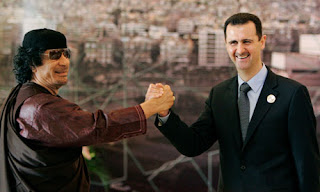

What is remarkable about the Arab Spring is that, for the first time in that region's history, the people themselves have taken to the street in revolutions that can be called neither capitalist nor communist, and are 'Islamic' only by an enormous stretch of the imagination. The radical politics of the nineteen sixties can be said to truly be running their course today, and these exhausted ideologies of a previous age are now being rejected by the disillusioned people who believed that its champions could free them and improve their lives. From the streets of Paris to the various Arab capitals, this radical liberation ideology has been adapted, twisted and manipulated into the present regimes we see today. The gradual fall of each marks the twilight of the Arab dictators and the failure of the radical politics which have defined the Middle East for over half a century. The real question is that if conservatism and radicalism have each, in turn, failed to deliver for the region, then what next?
.

Friday, September 16, 2011

The Sarkozy-Cameron visit to Tripoli was a victory visit, that is very clear. And why shouldn't it be...the strength of the West has, and always will be, based on the weakness of the Arab countries. Most importantly, the weakness of the tinpot dictators and tyrants that press their boots down on the chests of their own citizens is what keeps the entire Arab world in the gutter.

.

Thursday, August 11, 2011

The Myth of the Arab Reprobate

I saw somebody 'tweet' earlier that in spite of the brutal repression of the Arab regimes, they were much more progressive and secular than their people had ever been. They then added the 'tags' of #Egypt #Syria #Yemen #Libya. At first I wanted to reply immediately, to fire off a snide comeback. The comment made me angry on so many levels, but was a retort really the best way to respond? Probably not. Regardless, I wanted to think about why this comment annoyed me. What could drive somebody to say that the Arab regimes - in all their disgusting behaviour - are better than the people that they rule? Did this person have a horrible experience with ordinary citizens? Were they wronged so horribly, or seen something so shocking, that it made them think that Mubarak, Assad or Gaddafi were preferable to them? I cannot say, but I do know for certain that such a remark is misguided and cruel. For all the instability and horror we have been seeing over the past eight months, I cannot say that the status quo prior to the 'Arab Spring' would be preferable.

The Arab dictatorships did have a certain progressive air to them, and they did make great strides in terms of gender equality and the spread of education, but you can say the same things about the Nazis or about Stalin's Soviet Union. The fact that these dictators got something right does not justify in the slightest the existence of torture chambers, extra-judicial killings, arbitrary arrests and the lack of political freedoms. This is like saying a wife-beater is not so bad because he's good with the children and brings food to the table. But to be fair this isn't what the person who made that 'tweet' meant. They were saying that the people governed by the Arab regimes are far worse than a typical Arab regime. But even so, there are problems with this line of reasoning. An uncle of mine once told me that God sends the ruler that people deserve. My response to him at the time was that each generation gets its own ruler, and that this was his generation's ruler. That shut him up (and annoyed him greatly) but it portrays an underlying sentiment, very similar to our Tweeter above, of saying that we are somehow unworthy of a proper government or ruler. But this is a very unusual way to view the relationship between the people and those who rule.

Originally, the ancient Greeks believed it was a ruler who was responsible for the moral well-being of the citizens through laws. The better the ruler, the better the people. This was also a view that the Islamic philosophers also held onto, and one which existed in Europe throughout the Middle Ages and up to the Renaissance and Reformation. Even with the arrival of the 'modern' age, there was, as far as I can recall, no peculiar insistence that the people must somehow be worthy of a good government. The only parallel that comes to mind when I hear these arguments is the ugly 'Orientalist' assumption that the brown man was better off being ruled by the Europeans, and when he would revolt, that how dare he bites the hand that fed him. But that is being a bit unfair to our Twitter user.

I think that the fallacy in their argument lies is not the unwittingly Orientalist heritage it possesses, but in that they ignore the horrendous effect that these dictators have had on society. For over forty years, the goons and thugs of these regimes, be they literate or illiterate, have toyed with society, manipulated the people like puppets, and bullied, coerced or in some cases completely brainwashed a generation of people to become the very perversions which lie at the heart of an Arab dictator. Unlike the wise philosopher-king of the ancient Greeks, a king who would temper the people of his city into just and noble people, the present day rulers of the Arab world shaped their people into their own image: bastard gods manifesting their perversion into their own progeny. I don't deny that Arab societies, like any other, have immense problems. What I do deny is that these problems are somehow innate in the people, that this fruit we see today did not grow out of any tree, but was always there.

.

Sunday, June 05, 2011

Arab world roundup

It is amazing how quickly things can move when the right time has come. Saleh is now in Saudi Arabia for treatment and that means the game is over there. He will never come back to Yemen as President, nor otherwise if he knows what is good for him. Of course this does not mean that Yemen is in the clear, and like Egypt and Tunisia, there is a mammoth task ahead of the people as they begin reconstructing their country and picking up the pieces. In a sense, getting rid of the tyrants is the easy bit because after decades of authoritarian rule, the roots of injustice go very deep and will need to be dug out individually.

Speaking of justice, the events in Syria last Friday only highlighted how brutal and incompetent the Syrian regime is becoming. The fact that they blocked internet access to the entire country is a sign that they are weak. Regardless, we were stilling hearing news and videos were continuing to trickle out. Unlike 1982, the world is watching Syria and will not tolerate a repeat of the Hama massacre. More importantly, the Syrian people are watching what the regime does, and I am noticing that the actions of the security services are becoming less defensible by apologists and people who are undecided yet. The apologists are becoming increasingly detached from reality, posting links to government websites for "Tasharokia" (cooperative) projects and initiatives. What does Tasharokia mean, anyway? This seems like another case of regime double-speak, similar to Libya's Jamahiriya project, which is some kind of collaborative utopian vision where dictatorship merges with populism.

Still, today Syria has continued the trend of allowing protestors to reach the Golan heights, 3 people have died today by Israeli fire. I am very cynical about this manouevre, and I believe it is a calculated attempt to divert attention for Syrians away from the widespread protests that have engulfed the country for the past 2 months towards external events. Regardless, Assad's regime is now very isolated even if its position remains quite strong. This situation will not be over anytime soon, but it will be over.

Regardless of the Syrian regime, the Golan episode today highlights something very worrying for Israel. The loss of the dictators in the Arab world and a wave of revolution that is sweeping the area will affect them too. The borders will no longer be policed by regime secret police, and more and more people will be tempted to come right up to the border with Israel and attempt to cross it. Israel is no longer a distant bogeyman to be frightened of but rather it is a 15 minute drive away.

.

Monday, May 16, 2011

The UAE Blackwater story

I don't understand what all the fuss is about this mercenary army being formed in the United Arab Emirates. Gulf states have paid foreign soldiers to do their work for decades. Pakistan has an entire battalian ready to be deployed at a moments notice for the Saudis. In the Emirates, there are entire bases filled with Morrocan soldiers to operate the French planes and equipment for the UAE army. In Saudi Arabia, the United States was rewarded handsomely for repelling the threat of Saddam Hussein's Iraq in 1991. So why is it odd that, at a time of widespread discontent, some rulers are taking additional measures to protect their position? Blackwater, or R2 as they are now known, are not the sinister villain here. There have always been mercenaries as long as there has been war, so get over it.

.

The Arab Revolution and Nakba Day


The first Nakba day to take place following the Arab Awakening has been dramatic. I was particularly surprised to thousands of Syrian and Palestinian demonstrators rushing across the fences and mine fields into the occupied Golan Heights, under fire from the Israeli army. As is known, the Syrian side of the borders has been Israel's quietest since the Golan Heights were occupied in 1967. That doesn't mean that Syrians don't care about the Palestinian cause, in fact the regime's pro-resistance credentials are impeccable, but many will be cynical at what they believe is a publicity ploy by a regime intent on diverting attention away from the unrest it faces at home. A visit to the Syrian/Israeli border is simply not possible for average Syrians, and unthinkable for average Palestinian refugees, without countless security checks and clearance.

The interesting thing about the unrest that we saw on the Syrian, Lebanese and Gazan side of Israel's borders is that these three areas are all managed centrally from Damascus. Nothing could have happened spontaneously without the approval of the Syrian security services, Hezbullah and Hamas. Coming so soon after Rami Makhlouf's statements to the New York Times, that instability to Israel is tied to instability in Syria, this appears to the cynic to be a confirmation of that warning. But, supposing that this is a totally spontaneous expression of popular yearning to liberate Palestine, does this show that the Syrian regime is incapable of policing its border with its enemy? Of course not, but it can start looking that way. And when things start looking that way, something which people believed was invincible might just start to look vulnerable.

Israel might have an army that can defeat a conventional Arab army, but it has performed dismally against a popular and well dug-in militia. It will be even more difficult to stop individuals from crossing over alone or in massive groups without getting people killed, meaning that Israel's image will suffer immensely. But the flip-side to this story shows us that organised, centrally managed and state-focused, Arab initiatives to help the resistance have been execrable. Countries such as Syria, which focus their resistance agendas, can no longer be seen as the most effective form of resistance when popular groups that can no longer be controlled and manipulated are putting far better pressure on the Israeli state than they could ever wish for. Whilst the borders might usually be heavily guarded, this desparate act could be a genie let out of the bottle. At a time when the entire Arab world is erupting against tyranny, this is a dangerous game to play.

One thing that must be understood about the Arab revolution is that it is sweeping away both pro-Western and Resistance rulers alike. The entire political map of the region is being redrawn radically in a way that has not been seen since the 1970's. More importantly, it is not just Arab rulers that must fear what is happening but also the Israeli state. The people of the region cannot be manipulated along sectarian, ethnic and nationalist lines anymore. Instead, they have erupted angrily and will continue to do so until they get justice. It is a wise ruler who recognises this and begins to respond to the will of the people instead of just shooting them.
.

Thursday, April 28, 2011

The Arab World is Awakening...


At the risk of being slightly melodramatic, I felt this piece of music reflects the mood and temperament of the Arab world quite well. Enjoy Carl Orff's Fortuna Imperatrix Mundi.
.

Thursday, April 21, 2011

The Collector's Guide to Fine Arabic Propaganda

I thought it quite amusing that each Arab 'leader' has songs that extol the virtues of their wise rule, their glorious achievements, their outstanding bravery and their steadfastness and courage in the face of their nation's enemies. It is all really quite repulsive and nausea inducing.

The first is from my beloved Syria. The entire country loves the president. So much so that this singer whole heartedly and of his own volition released this song as a sign of his gratitude and love for the eternal leader of the Arab revolution.


Second is from the wonderful land of Saudi Arabia. The current King Abdullah is so beloved of his people, so benevolent, so wise. He is a bastion of stability against the evil Shi'ite hoards that threaten to overwhelm the holiest of holy countries, Saudi Arabia. He doesn't seem to mind the United States or Israel though.


Next is the cousin of the al Saud's, the al Khalifah family. They aren't really Bahraini as their family moved there a long time ago and took over, but that doesn't really matter. They own the island now, and everybody on it. You got a problem with that? They'll just bring in a few thousand Saudi soldiers and tanks and run over anybody they don't like.


We won't forget Ali Abdallah Saleh, the immortal leader of Yemen, uniter of the Yemen's, scourge of al Qaeda, moderniser of the nation. I didn't think somebody would have done a song for this guy, but it's out there. Enjoy.


This one is quite funky, it's for the King of Jordan, Abdullah the Second. His family used to own the Arabian peninsula before the Saudis came in and called it Saudi Arabia. Instead he ended up with a patch of dirt with no water, no natural resources and no money. But his people think he's great and I guess that's all that matters. He wears a lot of medals when in uniform and I don't know what they're for. Last time I checked Jordan never won any wars. Maybe he puts them on because they look pretty.


Finally, this one was kind of hard to find, especially since the guy in question is now so much of a joke and the Zenga Zenga song has dominated YouTube. Yes, we are talking about the King of Kings, Lord of Africa, Leader of the Glorious Revolution, Founder of the Islamic Jamahirriyah of Libya, Barack Obama's Father, the one, the only, Colonel Mu'ammar al Gaddafi. This song was for his son Khamis, but the illustrious leader is the main inspiration for the song, as you will see.


One late entry thanks to my dear friend Seleucid. Egypt's Mubarak has a song here which is probably the slickest and most professional of these clips. Very fascinating and the message is extremely subtle. You don't see Mubarak till the very end. I think this gets top marks.


.

Monday, April 04, 2011

The Farce that is the Arab Regime

The initial enthusiasm I felt with the success of the Egyptian and Tunisian revolutions has now subsided. The past three months have exposed the painful truth which many Arabs refused to see, which is that the biggest enemy of the Arabs is not America, Iran or even Israel. It is the Arab rulers. The Arabs today are a people divided into tiny squabbling kingdoms dominated by petty ruling families who are propped up by a complacent international system and brutal security services that imprison or torture all those who dare say that "the emperor has no clothes". These ruling families have each developed a cult of personality that would put Stalin to shame. Over the past few weeks we have seen a concerted attempt to quell the tide of Arab dissatisfaction. Massive subsidies have been put back into place, wage increases for the public sector, free mobile phone minutes. All these actions, it is hoped, will quiet down the people and return them back to a docile and manageable state.

Furthermore, governments have also been sacked, apparently the puppet masters are greatly displeased that their puppets have not entertained the masses as they should have. Even al Jazeera's coverage has been toned down recently with regards to the protests in Syria and Bahrain. This is something which has been particularly surprising and troubling to me. It appears that pressure has been brought to bear on the Qatar based network, and whilst still maintaining extremely high standards, the channel is not as daring as it was whilst covering the fall of Mubarak. Ultimately it seems that the Arab revolutions are a threat which has been recognised by all Arab rulers, and this has united them in a way that no external threat ever could.

Yet whilst I feel despondent that change will not be as quick as I expected, I remain optimistic that the fear barrier has been broken. Even with Syria, I can see now that people are much more open in their views about the government, much more ready to give their opinion, than they would have been a year ago. It simply will not do to claim resistance, modernisation, or having a charming trophy wife, as a means to placate the masses. The people have seen through that, and they have seen how weak those who govern them really are. Something is changing, I just hope it is permanent.
.

Saturday, February 19, 2011

ام كلثوم - انا الشعب


This song has been playing on al Jazeera during its breaks. It is by Umm Kalthoum, the famous Egyptian diva, and it is called "I Am the People". I can't stop playing it.

.

Saturday, February 12, 2011

The Real Evils plaguing "the Real Evils Plaguing the Region" - a response to Buthaina Shaaban

Ms. Buthaina Shaaban, the political and media advisor to the president of Syria, has written an article on Forward Magazine's website about the Egyptian revolution. Considering her quite visible role as a representative of the Syrian government it was interesting to see her response to this historic event. However I was quite disappointed with its context and ambiguous conclusion, and I felt compelled to respond to some of her assumptions. Having received direct responses from Ms. Shaaban for emails that I had sent her commending her various foreign policy statements, I do hope she responds as earnestly to well intentioned criticism - otherwise I will have a very uncomfortable stay in Syria the next time I visit. Below is a copy of my comment to her article.


Ms. Shaaban, you have written a timely article which exposes the considerable hypocrisy underlining Western relations with Arab countries, however, I feel your article has not done justice to particular aspects of the Egyptian revolution; Aspects which can portray a deeper and far more uncomfortable reality facing the Arab world than the geopolitical machinations you expose so masterfuly.

The Egyptian revolution was not only a revolution against the Mubarak regime's execrable foreign policy, nor only against the relegation of Egypt to the role of a US vassal in the region. In fact, not even the deplorable conditions of the Gazans, exacerbated by Mubarak's assistance of the Israeli siege, were the largest motivation for this revolution.

The fact remains, and must be stated however uncomfortable the reality, that Egyptians were revolting against the arbitrary nature of their government, the endemic corruption and police brutality, and the complete disregard for the "rule of law" that became characteristic of Mubarak's regime.

Whilst Egypt and its other Arab allies might be guilty of their complicity with the United States and the criminal entity in our region, one cannot honestly say that the arbitrary and harsh nature against which the Egyptian people revolted is unique to these regimes alone. To say that outrage over what happens in Iraq and occupied Palestine is the prime motive for the discontent of these people is a crass understatement which neatly sidesteps the "elephant in the room", so to speak. This may, perhaps, explain the rather ambiguous conclusion to your article.

Understandably this is an uncomfortable topic to broach, particularly for someone in as sensitive a position as yours. Being an "Arab Citizen" used to mean something once, it was a privilege which granted its owner the right to speak, to be heard, and to be involved in how their country is being governed. It is a privilege which also demanded respect, and to serve the citizenry was a role which instilled a certain sacred awe in government officials. Surely we cannot all be so obtuse as to not recognise this fact?

Sincerely,
Maysaloon

.

Tuesday, February 08, 2011

Not all Revolutions are Equal - A Comparison between Egypt and Iran

One would think, watching the BBC or CNN, that the Egyptian revolution is winding down and that the people are going back home now that talks have been commenced with the regime. That is not surprising. Since the 25th of January I've found that Western coverage of the protests has, at times, verged on the half-hearted. The picture is completely different with regards to the coverage provided by al Jazeera, that has been providing almost round-the-clock analysis and coverage of the current Egyptian revolution.

The difference between the BBC and the coverage of al Jazeera could not be more different, yet I remember that the BBC seemed to find the so-called 'Green Revolution' in Iran far more fascinating. At the time there was in-depth coverage, analysis and up-to-the-minute information on what was happening in the streets. When Neda Sultan was shot at one of the protests she was immediately turned into the face of that revolution. Yet countless Neda Sultan's were shot dead on the streets of Cairo, Alexandria and Port Said over the past 15 days but we have yet to see a single one of them appear on any Western news outlet. Not one BBC journalist has visited a victim's family, or attended the funeral of any of the protestors. The horrific footage of cars plowing through crowds of protestors or of people being shot in the streets have not provoked as much concern as they would have if they were filmed on the streets of Tehran.

Even the language of Western statesmen has been far more diplomatic and reserved with Egypt than it has been with Iran. In fact the most prominent concern aired for these statesmen has been their fear of a replay on the Iranian revolution in 1979. The idea that Egypt might have a revolution like that of Iran is very unsettling to the West, hence the emphasis by Obama on 'orderly transitions'. This is because the removal of Mubarak is acceptable, but the removal of his regime is not. This regime (inspired by the former president Anwar Sadat) maintains peace with Israel and disrupts the activities of dissenting players in the Middle East such as Hezbullah, Hamas, Iran, or Syria. It is a key ally of the United States and its internal security apparatus help keep the Arab world's most populous and influential country under a tight leash. As a result, all this makes Egypt a prize that is far too valuable to lose.

In a recent blog post I pointed out that it is not wise to equate a day of rage between a country like Syria and that of Egypt. The reason I did that is because these revolutions are not taking place in a vacuum. There is a power struggle in the region between the United States and the regional powers such as Iran, with whom Syria is a key ally. For Tunisia, Egypt and Yemen to drift into the orbit of the 'opposition' states in the region, leaving Saudi Arabia and Jordan alone as US allies, would be very dangerous for the interests of the West in the area, and potentially for the security of the key US ally, Israel. What raises interesting questions in the coverage of Western news outlets between the protests in Egypt and those of Iran is how neatly the coverage coincides with the strategic interests of the United States and her allies. That raises deep concerns about the supposed impartiality and professionalism of these news outlets, but it also gives high hopes for Arabic channels such as al Jazeera that have succeeded in creating an alternative platform for the Arab world to voice its interests.

.

Monday, January 31, 2011

Even Our Dictators are Pan-Arab

There is, I think, a marvellous pan-Arabism that is being expressed in this wave of revolutions and unrest that has swept the Arab world. Average people on the street from Yemen to Morroco are watching al Jazeera and cheering the events taking place in Tunis and Cairo. Furthermore, the ousted Ben Ali could only find refuge in an Arab country, Saudi Arabia, because the Europeans and Americans wanted nothing to do with him. Recently the Libyan and Saudi governments made statements that supported Mubarak's regime. It seems that even our dictators are a pan-Arab family who look out for one another.

.

Friday, December 24, 2010

'Twas the night before Christmas

Twas the night before Christmas, when all through the house
Not a creature was stirring, not even a mouse.
But this year was different within the Middle East
For there will be no Christmas dinner, no turkey feast

For the first time in decades in grand old Baghdad
Noel won't be coming and there are none to be sad.
For here in this city, for the first time in ages
Christians are fleeing, erased from her pages

But in the Holy Land surely, things must be different
Yet for some strange reason festivities are absent.
King Herod has spoken and issued an edict
Christmas is cancelled in the Nazareth district.

Santa came by in his magnificent sleigh
To give out his presents and be on his merry way.
He tried to stop by and visit the Nativity church
and instead was given a full-body cavity search.

He sprang to his sleigh, to his team gave a whistle,
And away they all flew like the down of a thistle.
But I heard him exclaim, ‘ere he drove out of sight,
"Happy Christmas to all, screw you and good-night!"

That is probably not how the famous poem goes, but then again, it is not natural for the Middle East to slowly be emptied of its Christian communities. In Iraq Christians are leaving in droves whilst in Nazareth Christmas celebrations were cancelled by the Israeli mayor. It is quite telling that in the two Arab countries under direct Western occupation in the region, the plight of Christians there has never been more dire. There is probably more Christmas cheer in Riyadh today than there is in Bethlehem.
.

Thursday, November 18, 2010

Criticism of the Criticism of the Arab Mind

Hardly an original title to a blog post, but al Ghazali would surely forgive, and may in fact support, the premise behind using such an article. There is a phenomenon that is rapidly growing within the 'educated' circles of Arabs that I meet, the phenomenon whereby something called "The Arab Mind" is seriously debated and considered. I understand there are books written by Orientalist and Zionist authors which deal with such a subject, usually from an extremely derogatory standpoint, but to hear Arab students and lecturers using it wantonly without regard to the subject matter is very sad. I am aware of the very popular book by the late and respected thinker Mohamed Abed al Jabiry, but I have not read it and this critique is probably not related with the subject matter he deals with - or at least I am not in a position to make such a speculation.

Usually the critique of the "Arab Mind" is done by quite educated and urbane students and lecturers who tie this in with a sometimes barely concealed resentment of Islam in particular. To my surprise, their narrative is composed of an oppressive superstructure on the one hand, and a repressed intellectual minority on the other. This minority is the only part of Arab society that is capable of free thought or individuality. Secondly, to avoid being labelled as Westernised, there is a construction of Arabism and nationalism, infused by the very political ideologies of the regimes that they despise, and centered around ideas of freeing Palestine, which in their view help them to redefine themselves as Arabs, but without the uncomfortable baggage of Islamic history.

Under this umbrella, you get a cacophony of half-baked and misunderstood ideologies and even less misunderstood philosophies. There is no logical basis to their arguments and they appear to have also occupied the bastions of "Political Correctness", condemning and damning all those who are misfortunate to utter a sacrilegious statement in their presence. In their eagerness to destroy what they perceive to be an oppressive society and status quo, they create a new atmosphere where one is constantly forced to purge themselves of what they deem to be regressive thoughts and impulses. I find it incredibly tiring to be discussing a particular issue, only to be sidelined completely by one of these clueless rebels who take offence to a mannerism or particular word I use. The discussion, it seems, must always be about what interests these vain attention seekers. These interests are namely vague and ridiculous investigations akin to discussing the definition of the colour blue ad nauseum.

Most of the discussions I have concerning articles or posts that I write are not about what I actually have said, but about what I haven't said, or about the assumptions of these individuals. The discussion is then about my failure or success in measuring up to these assumptions. Luckily, I have learnt to ignore such distractions, but I am left deeply worried by these droves of individuals who have gone abroad to study at the world's finest universities and are returning to their home countries not with an education, but with an attitude.

The internet, twitter, facebook and the whole panoply of social networking and online collaboration has not given a voice to the voiceless, but instead it has provided a platform for the idiotic, ridiculous and petty squabblers. Coupled with slick graphic design skills, the inane is given a respectable and credible image. Ideas are no longer discussed for their own merit, but rather they are judged on how non-offensive and non-discriminatory to stupid people they can be. The greatest danger and challenge facing humanity at the dawn of the twenty-first century is not radical Islam or a Messianic United States, but stupid, amoral people with Macbooks and Twitter accounts.
.

Wednesday, August 25, 2010

خواطر 6 الحلقة 4 - khawater 6

A friend of mine introduced me to this new series which is being aired during Ramadan. I think the guy who is presenting this programme is a fantastic person with lots of enthusiasm and talent. The series itself is excellent and touches on some great issues. Enjoy.

.

Saturday, June 19, 2010

Strategic Map of the Middle East and North Africa - 2010


In 2007 I had a post concerning the strategic makeup of the Arab world and the Middle East. Click here to see the map with the dots. At the time there were some interesting observations, countries with blue were firmly within the American/European/Israeli orbit, countries with the red dots were in the Eastern/Islamic/Pan Arab orbit. Some countries had both dots, like Iraq, and it was clear that there was a conflict in those countries. Fast forward three years and we find some surprising changes to the strategic makeup.

We start from the lands of the Maghreb, where we find that Mauritania's position regarding Israeli occupation has led to extremely loud and principled positions. This has been more than just popular protesting and has creeped into officially firm stances in some instances. This gives Mauritania a red dot whereas in 2007 it had a blue one.

Algeria's firm stance supporting the Palestinians, the presence of Algerian MP's on the "Freedom Flotilla" and Algeria's increasing involvement and voice in Arab and Islamic issues following a long period of isolation and civil strife marks its gradual return to the Arab/Islamic orbit. Algeria is a firm red dot where in 2007 it had a blue dot.

Egypt and Sudan are both countries on the verge of major changes. Sudan is earmarked for dissection by the Western powers through its oil rich south. This is the result of a steady and unending campaign that began with the sham "Darfur" circus ignited shortly after 2003 to deflect attention from the American occupation of Iraq.

Egypt is awaiting the imminent death or abdication of President Husni Mubarak, it is unknown who will take power after him, but Egypt's position is near exploding point and therefore it is far from certain that Egyptian officaldom will remain firmly in the Western orbit. Therefore Maysaloon gives Egypt both red and blue dots.

Israel is, of course, a blue dot, but the rise in Hamas' importance means that a red dot has emerged where in 2007 the area was firmly covered in blue dots.


In Eritrea, the presence of both Israeli and Iranian or Hezbullah operatives in the region make it a disputed hotzone, it could go either way and is currently an intelligence playground.


Somalia is now firmly a red dot, the rise of piracy, withdrawal of the Ethiopian army and renewed strength of Islamic groups has given the country a red dot. In 2007 it had a blue one.


Yemen too, the uprising of the Houthis (backed by Iran) gave the Saudi and Yemeni government much to worry about. Increasing Iranian naval influence off the Yemeni coast and the increasing strength of Islamic groups there all give Yemen a firm red dot.

In Qatar there are two dots, red and blue. Qatar is playing a key role between the two sides and is a key partner of Iran, Syria and, now Turkey.

Lebanon is now firmly a red dot.

Turkey is the surprise change of 2010, from a firm blue dot in 2007. Erdogan's government has made increased moves eastwards and appears to have made a strategic choice to strengthen ties in the long term with her Eastern and southern neighbours. The future is still uncertain, but for 2010, the red dot is now, surprisingly, strong in Turkey.

In 2007, there were two dots, one red and one blue to highlight the resistance movements in Iraq to the American occupation. The American conceding of Iraq to Iran, whilst a blow to Arab and Sunni nationalists, marks Iraq as firmly within the red orbit in spite of the existence, for now, of American troops in the country. This is unlikely to last much longer as the United States prepares to leave by setting up a miniature army to protect its embassy and interests there, but with the expectation by Maysaloon that American military presence will be scaled back quietly over the next five years.

Additions to the map are Afghanistan and Pakistan. Afghanistan is now firmly with a red dot, the Taliban are poised to overrun the country as soon as the Americans, who are unable to control the countryside, leave. Rumours are that President Hamid Karzai might be negotiating with the Taliban.

Pakistan is in dispute, the assassination of Benazir Bhutto put any hopes of a firm blue dot in Pakistan in severe doubt. Pakistan has many problems but because the West has been unable to consolidate a firm grip on the country through a strong central government, something lacking at the moment, Pakistan today deserves both a red and a blue dot. The firm post 9-11 alliance with America is on extremely shaky grounds, whatever remnant of it still exists.
.

Sunday, May 30, 2010

Parlez-vous Arabe?

It's so difficult having a discussion with an ignorant person. I know I'm supposed to be patient and sometimes I even manage it, but I really wonder whether the democratization of information, the internet and this whole new-media revolution have really only provided a platform for stupidity. I read some of the other posts on other Arab websites, or some of the comments I get here, and I shake my head in despair.

I think that's why I'm generally happy that there has been progress on making non-Latin domain names. The Arabic speaking populace that might have been intimidated by their lack of knowledge of the English language can now gradually make inroads into creating an entirely Arabic speaking portion of the world wide web where they can express themselves comfortably and clearly. This is particularly important because it seems to me that a very vocal minority of English speaking Arabs from across the Arab world are utterly and completely subservient to the United States. Particularly from the Gulf region and from Jordan. In fact Jordanians strike me as utterly bizarre, they have a reverence for their king that no other people in the region would do, an extremely unhealthy attitude. As for Arabs from the Gulf, well the English speaking ones I've dealt with seem to hate anything to do with Islam and just refuse to acknowledge their country's status as US protectorates. They seem to only remember their sovereignty when we are talking about Iran or about other Arab states. It's quite sad talking to some of them, without realising it they are often more racist and anti-Arab than Zionists or Zionist supporters.

So ultimately I think I've given up on a large part of the English speaking Arab blogging sphere. As more people use the 'Arabic' internet perhaps finally we can overturn this monopoly that has been established by self-styled 'liberal' Arabs and maybe then they can start to feel a bit of shame. Bring out the crass, the prejudiced, the highly opinionated, the highly critical and the highly politically incorrect Arab masses. Self-confident in the uniqueness and importance of their own world. I say to you, forget about those people who pretend to be civilized and are trying to "civilize" and shackle you. Let them shake their heads in despair!

The world will know that it is "scientifically" proven that Mecca is the centre of the world, that water molecules vibrate and are charged with "positive" energy when you recite the Qur'an according to a Japanese "scientist". Send them mass e-mails proving that "Western scientists" are converting en masse to Islam as they discover more miracles, miracles that Abul Abed the taxi driver would have told you the Qur'an (which he's probably never read by the way!) in his glove compartment always told him. Share the word on magnetised soap bars that dangle from a plastic hand over the sink and teach the world the importance of washing their posteriors after a number two (Seriously, many Europeans and Americans only use toilet paper). Stake your claim for a place in this world oh Arab street and step up with pride. I love you...

.