Tuesday, August 30, 2011

An Armed Uprising in Syria?

Nothing quite says f*ck you like killing seven people on the first day of Eid. This is Bashar al Assad's gift to the Syrian people. With behaviour like this, I'm not surprised that more and more Syrians are starting to call for a 'Libyan' solution to the bloodshed in Syria. By this, and I will disappoint the anti-NATO vultures, I do not mean they will start asking for the West to bomb the Syrian army, but rather that Syrians themselves will start to take up arms against the regime's security services and thugs. The logic behind this is that since people are already being killed, they might as well be armed and have a fighting chance.


I can't say I agree with the soundness of this logic, but I can't say I blame them for calling for such a drastic solution. In six months, Bashar al Assad's stupidity has dragged the country to the verge of civil war. From a mildly popular dictator, he has now become the most hated man in Syria, with the demonstrators now openly asking for "the execution of the President". And rightly so, the deaths of 2,200 Syrian citizens by the security services and paramilitary thugs is inexcusable and Assad is squarely to blame for this. This man has now single handedly taken the entire country into the unknown, rather than respect the wishes of his people and leave willingly. The longer the killing continues, the more likely an armed uprising might become, and the more uncertain the entire country's future begins to appear.
.

Monday, August 29, 2011

I don't know how accurate these reports are, but not enough is being said about the rate of defections from the Syrian army. This lousy army has never hesitated to fire upon Syrians and yet allows Israel to bomb its way up and down the country. Instead of calling it the Syrian army it should be referred to as Assad's militia, for that is whom they serve. It amazes me how blasé I've become towards the sight of Syrian tanks and soldiers wandering the streets of Syria, let alone the sight of their thousands of victims. I don't want to get used to such views, I want to remain outraged. And I will.

If these defections continue at the rate they are going, then nothing will happen. What needs to take place is a mass disobedience of the army towards its officer corps. The backbone of the Syrian army, like any other, is its officer corps. If they are disobeyed, then a major factor in Assad's grip on the country will go away. At some point, somewhere, there have to be enough breaks within the command structure to render it ineffective. That is when you will see the regime start fleeing.

.

Some Comments on Libya

There are some who have an almost voyeuristic satisfaction whenever they hear of NATO bombing civilians by accident in Libya. Not once, have I ever seen them mention anything about, or express any sympathy for, the victims of Gaddafi's family and their sadism. Here, Gaddafi's daughter in law pours boiling water over her Ethiopian nanny. Here, Khamis al Gaddafi's brigade massacred dozens of people in the warehouse. But, of course, heaven forbid that NATO should get its hands on any Libyan oil.

But wait - what oil are these people talking about? Is it the same oil that was already available in Gaddafi's Libya after he came in from the cold? Didn't BP sign a major exploration and production deal with Libya? What was ENI, the Italian oil company, doing in Libya for all those past few years? So Libya's oil was already going to the West? Oh dear... where does that leave their argument then?

What is sad is that instead of placing the blame firmly on Gaddafi's idiocy, that has made NATO intervention in his country possible, these individuals continue to blame the Libyan people, his victims. In that sense, they are no different from those who support Zionism and blame the Palestinians for the misery they are in. Dogma, it seems, can be found in politics as well as religion.

.

This announcement of a 'National Transitional Council' in Syria is a bit premature and ill-planned, but it's necessary. The reactions of Syrians I know when the news started spreading was almost euphoric, and the people who have been selected to be a part of it are popular and held in high regard because of their positions so far. Still, the way this has been managed is very bad, and it makes the opposition look bad. Oh well, you live and learn.

.

Syria's only hope?


We're f*cked...
.

"Landis Watch" Update

It seems that Landis is taking a much more conciliatory tone towards the Syrian opposition and the Syrian 'youth'. He said that they have shown 'tremendous courage' which is a big improvement from the tales he regales us with usually. And this time he hasn't cited any 'credible sources', such as his wife's cousin Tahseen, their cleaner lady, and, of course, Valerie, the American housewife in Lattakia -sorry, businesswoman - who told us a few days ago that people were being 'dropped off' by buses at the sports stadiums (as if one were simply taking the 186 bus from Brent Cross), where they were being looked after and fed by our kind security services. Y'all take care now.

[End of Maysaloon commentary]

.

Bassam al Qadi - Again

Bassam al Qadi is a self-styled 'intellectual' who specialises in being daring with topics that he is allowed to speak about. In what seems like a life-time ago, I criticised his stupid position where he supported the so-called 'niqab ban' that the Syrian regime's education minister had put in place - at around the same time that France had put this law in place. On a side-note, at the time I was vehemently against the ban, but today - as I review some of my old comments - I'm quite startled with how differently I saw the Syrian regime last year. Then again the Syrian regime hadn't killed three thousand Syrian citizens yet. But that is another discussion for another time.

Anyhow, going back to Bassam al Qadi, apparently the guy has his own website now. Like most Syrian 'intellectuals', he uses his own name as the address (and "brand"). What a vain, ridiculous, man. Oh and he has written an article (linked above) where he mauls al "Arabiya" and al "Jazeera" for 'conspiring' against Syria. A very stupid article where it is very clear by now that he is a regime mouthpiece and a keyboard-for-hire sycophant. With hindsight, I am not surprised that this pseudo-secularist and pseudo-intellectual would have supported the regime's silly niqab ban as vehemently as he did last year. One of the things that I look forward to when this oafish regime collapses is to buy some balila from somebody like Bassam al Qadi, because in a free Syria where stupid people can no longer be put in charge of NGO's, government agencies or newspapers, he won't be able to find any other kind of useful employment. Did I say he's a silly man who is vain and ridiculous? What a silly man.

.

Friday, August 26, 2011

Interesting Abdel Nasser Speech About Syria


I know that Nasser was far from perfect, but when I found this speech of his about the Syrian Baath party, I thought it was quite interesting: with hindsight, the man sounds almost prophetic today.
.

A tribute to the Noble Syrian Peasant

For all the rhetoric of Unity, Freedom and Socialism, the Syrian Baath party has delivered none of these three. With the overthrow of Salah Jadid's radically leftist branch of the Baath, Hafez Assad introduced a corporatist, corrupt and highly repressive state apparatus that excluded all those who did not share his vision for the country. Syria became "a Fatherland" with a cult of the leader, an ideology that tolerated no dissent, and a corrupted intelligentsia that reinforced the new status quo. Members of the old system: educated; cultured; or religious, were driven into exile. The old bourgeois families were completely marginalised as the village peasants took over the country's institutions. Of course, for all the talk of liberating the countryside (or Palestine for that matter) and implementing a truly socialist experience, the new rulers of Syria were eager to take on the trappings of a new bourgeois class.

Today we see their children in sensitive positions throughout the country. Clever, but unimaginative and predictable, this 'educated' class has never known the poverty of their fathers, and have grown up with an undeserved sense of entitlement in Syria which leads them to treat it as their personal estate. In an expression of Hegelian  dialectic history, they overthrew the landlords in order to themselves become landlords. Yet now they find that true power is not with them, but in the peasant class that they came from, and whom they have now alienated. When they hysterically denounce the protesters as 'salafists' who wish to destroy the country, what they are really terrified of is losing their privilege and returning back to the village. That is the root of their terror. So they pull together and utilise all the networks and contacts they have cultivated over the decades - in the hope of gaining some semblance of respectability rub off on them - to give their rule some measure of legitimacy. Like most people who lack vision, yet find themselves in positions of power, there is a qualitative difference they can never understand between a Syria firmly under their boots, and a Syria that is free from the rule of the peasant thug.

Ironically, and luckily, it is not the rotten Syrian bourgeois who are leading the revolt: after forty years of Assadist rule, Syria's "old guard" have come to a comfortable understanding with the Assad family. Instead the Syrian revolt began in Syria's rural areas, by the Syrian peasant himself, and not in the corrupt and cynical cities, where right and wrong can be viewed in so many shades of grey. In the countryside, where the corruptness of the regime's officials has a much more difficult effect to bear than in the cities, right and wrong are treated as matters of life and death. It is the noble and ignorant Syrian peasant who has risen now to overthrow the shackles of oppression and corruption and it is amongst his ranks that most of the three thousand martyrs in Syria's uprising can be found. Remarkably he sacrifices everything not in order to rule, but to live in dignity. After Deraa, all the uprisings we are seeing in Syria's cities today are just an echo of his first defiant cry.

.

A Brief Tour with the Syrian "We Love You" Crowd

"He said, she said" Accounts from Syria Comment

I like to check the pro-regime website, Syria Comment, every now and then just to see what the 'other' side is up to. Today they had a report by an American woman - she's described as a business owner - basically saying that everything in Latakai is actually ok. She says that the people being held in the stadium in Lattakia were refugees, and that a prominent family, the Joud's had donated a truckload of food so people could break their fast (this claim counters reports that people are being incarcerated and tortured in stadiums). She also says she thinks it is quite credible that there is an armed opposition, and that the army is being targeted unfairly. In effect, I think her report is published in full because it raises that all important 'reasonable doubt' that regime apologists like to hide within. There isn't really anything in her report which is concrete, or solid. All you will find is hearsay and opinion. For example, in one part she says she saw a Palestinian girl being arrested after weapons were found in her apartment. For some reason this leads her to believe that there are armed opposition groups. But her language is very ambiguous; did she see a Palestinian girl being arrested AND see them find weapons in her apartment? Or did she see a Palestinian girl being arrested and assume, or was told, that the reason was because they found weapons in her apartment?

In another part of her commentary she says an 'ex-pat' friend of her's saw somebody setting up a sniper rifle on a rooftop. She says he was arrested 'after somebody else called the police'. Again, the same questions raise themselves. Did her friend actually see somebody call the police, and how did her friend know that this man was a member of these shadowy 'opposition' groups? These are all strange statements to base such strong assumptions on. As is the habit with contributors to Syria Comment, she also cites 'credible sources' that conveniently lend credence to 'rumours' of so-called 'opposition fighters' taking control of the Palestinian camps or of parts of Lattakia. Of course these sources invariably reinforce this narrative, which is the only one the Assad regime tolerates.

Overall, I get the impression that this account had been published in order to promote the government's narrative. In the same post on Syria Comment, a second quote from "a Syrian from Aleppo" belies the neutrality alleged by some who speak about 'both sides', as if Syria was at war. This position is a strange, but quite amusing one, where the government is usually chided (gently) for not allowing peaceful protests, but at the same time gives full credibility - based on similarly foggy accounts as the business man's wife above - to stories of some kind of salafist inspired uprising taking place in Syria. Stories like this generate an artificial debate, and add an extra level of confusion for people who might not have a full idea of what is happening in Syria yet. Again I think this kind of behaviour is intentional and the language used is deliberate.

The Professional Liar

On another note, a certain "We Love You" spin-doctor I know, and one who has positioned himself as a kind of 'devil's advocate' for the Syrian regime, posted a particularly offensive comment on Facebook recently. A picture by Ali Ferzat was dedicated as follows: "A cartoon by Ali Farzat for the people of Libya who are happy to replace their lovely leader with an even lovelier new leadership that welcomed NATO's military intervention and Israel's "help"."
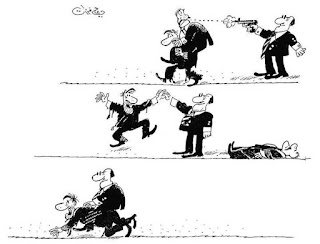

Ali Ferzat was recently beaten up by the Syrian mukhabarat in Damascus because of the cartoons that he drew, where he was critical of the Syrian regime and its violent repression of the protesters (This got a fleeting mention on the Syria Comment website, by the way). The irony of using this picture, by this man, to discredit a revolution against a key ally of the Syrian regime, is clearly intentional and aimed to offend. My spin-doctor acquaintance now seems to be working on overdrive to discredit and offend fellow Syrians - left, right and centre -if they dare to criticise his beloved Syrian regime - and he does this with a slight tinge of desperation.

With Us Or Against Us Mentality - The Syrian 'Twitter' Army

One final note, I am noticing that regime apologists are themselves the ones who are raising fears of NATO intervention in Syria to a fever pitch. Anybody who supports the Syrian protesters is now de facto also supporting the foreign intervention in, and occupation of, Syria. People are jumping onto my Twitter feed and, unprompted, begin discussing the reasons for my support of a NATO bombing campaign in Syria, even though I have never held such a position and don't advocate it. This crude attempt to hijack the course of discussion is something people have to be aware of. It is, again, an attempt to create an artificial debate, with the intention of swerving the discussion about the Syrian uprising away from legitimate demands to some abstract level with lofty proclamations against colonialism and imperialism. I find that bringing these people back down to earth is usually a good response and a better start to any discussion

I'm going to keep updating my posts with little tid-bits that I come across from the Syrian 'We Love You' crowd. Their non sequiturs, illogical statements, and - at times - blatant lies, make for a fascinating insight into this era of Arab fascism that we are slowly recovering from.
.

In terms of revulsion, I find it just as offensive when apologists for Assad or Gaddafi announce their support for the Palestinian people as when Israelis or neo-liberal Arabs feign support for the Syrian people.

.

ام كلثوم - رباعيات الخيام.


It's been so long since I put anything for Um Kalthoum; so much has been happening. This Thursday night, before tomorrow's horror unfolds in Syria and the rest of the Arab world yet again, I share some beauty from a simpler time.

There is nothing I love more than listening to this woman's music late at night, with the lights off and the window open. Magically, I am transported back home, wherever - and whatever - that is. Listening to Um Kalthoum, I know I can live, love and laugh again. This song is particularly interesting to me, it is the Rubayyat of Umar Khayyam, the famous persian poet, philosopher and sufi. In a nutshell, Um Kalthoum recites some of his words, as translated into Arabic, where he explains his misfortunes and the trials of life that he has failed at so dismally, only to ask for redemption simply because he never worshipped any other but God. As I lie in the dark, listening to these words that were already old when this song was sung, I find I have a lot to reflect upon.
.

I am certain that the National Transitional Council (NTC), in its desperation, has agreed to sell its soul in order to save itself from Gaddafi. I won't judge, condemn or preach to them about their decision. As Libyan people who suffered the most horrific oppression under this mad colonel, it was always their own decision to make, and I respect that completely. I don't respect those pseudo-resistance types who, whilst accepting that Gaddafi has to go, drool at the mouth whenever they find evidence of the strong ties that the NTC will be having with the West. Where were these resistance types when Gaddafi's soldiers were shooting at unarmed protesters with anti-aircraft guns and mortars? For people who are self-described anti-imperialists, their behaviour towards the people they are supposed to be "anti-" for seems to lack an awful lot of compassion and empathy.


I don't mind somebody who tells me they support one camp against another, that they are after their own self-interest or that they benefit from the favours of one particular ruler: I can appreciate the motivations behind human nature. What I don't like is the self-deception these people try to convince me of as true. The devil doesn't need an advocate.
.

Accepting Life with Simplicity

What does it mean, to "know" somebody? Does it mean you know what kind of human being that they are? Or does it mean that you know what they are and are not capable of? These are questions that are often on my mind these days. People drift in and out of your life. Some of these people mean more to you at the time than others yet, after a few years, that meaning slowly starts to evaporate. What made a person special to me? Or to anybody for that matter? At one time, I might have thought they could do no wrong, and yet be absolutely surprised with their behaviour later, shocked even. But if the importance I give to events, people, or places rises and falls according to - to what exactly? What is it that assigns that importance, that makes a woman, or a certain cafe or song on the radio, more valuable to me?

The importance is something I assign by myself, and whilst when I was younger such importance was underlined by desires, bravado or any other emotions, today I feel something higher driving this cost-exercise. I say higher, simply because that's the first kind of description I can give to using my head in making decisions. It's the uppermost part of my body, and so it is 'higher' than, say, my stomach. But that doesn't mean my head doesn't tell me to assign importance to anything or anyone at all, it simply warns me against assigning importance unwisely. So going back to my earlier question, what does it really mean to know somebody; anybody? Well, it could be that you've have built up enough knowledge of their past behaviour to assume that they will continue to behave that way in the future.

Naturally, like many things, that doesn't mean a thing for the one time when they do things differently, but maybe that's all we can ever hope for. Rather than a set certainty, based on some unshakeable principles, perhaps all means of knowing someone truly are just hopes which are encouraged by past behaviour. In the end, our desires cling to the straws of what we find with our senses. We clutch at straws and in our desperation see them as strong ropes that will save us from drowning. It's quite sad really, and it shows how vulnerable human beings are, even in our thoughts and minds.

I see this vulnerability every day: within myself and amongst the people I meet. We walk around, thinking with certainty, arguing, jostling, and getting offended or causing offence, because of the way we see things. We are always convinced that we see things as they are. But perhaps the only thing you can really do is nothing at all. That's a very Zen-like thought I'm grasping at, this late at night. I lie in bed now, accepting the world with a simplicity that would have horrified me only a few years ago. Perhaps this is the only way we can receive the surprises this universe stores for us.

.

Thursday, August 25, 2011

Ali Ferzat Arrested in Damascus

I have been hearing news that Ali Ferzat was arrested in Damascus in the early hours of the morning. Ali Ferzat is one of the best Syrian political cartoonists out there. I guess the regime got tired of his satire.

Update: By the way his website www.ali-ferzat.com appears to be down as well.
.

Monday, August 22, 2011

Why Libya will not be Iraq

For many, including myself, Libya will be a bitter/sweet pill to swallow. That is because the rebel's victory over Colonel Gaddafi was only possible because of NATO involvement and an extensive bombing campaign that virtually nullified his armed forces. On the one hand a massacre of the Libyan people by this erratic and highly dangerous individual was avoided, but on the other there is the very real risk that Libya will now be a vassal state to the West. Of course the Libyan people have made their decision, and the jubilation they are showing in the streets of cities across the country is a clear sign that they prefer this alternative to having Gaddafi and his family ruling them with an iron fist. There is, however, the argument that points us to the 'Iraqi' scenario. As a Syrian, I'm quite used to hearing the argument that democracy 'didn't work' in Iraq and that we should remember how nearly one million Iraqis because of the invasion. But the analogy does not work for a number of reasons.

In Iraq, democracy was, allegedly, to be applied by an invading American-led force that would completely purge society of the Ba'ath party, remove Saddam Hussein and then sit back and let favourable oil and construction contracts do the rest of the work. In Libya there are no American tanks and no columns of invading American and British soldiers. The ground fighting was done entirely by Libyan rebels, and, contrary to exaggerated claims, you cannot occupy a country by air power alone. Nor do ships off the coast constitute an occupation. What we should acknowledge is that this was a Libyan rebellion which was assisted materially by NATO. To say otherwise puts the donkey behind the cart and verges on the dishonest.

Secondly, the instability and deaths that occurred in Iraq were not entirely because of American bombing, in spite of garish propaganda posters of the victims of such bombings. Iraq was a battlefield between Iran and the United States. By proxy, a cacophony of groups emerged in the chaos and began to fight for control, including al Qaeda. All these groups, whether aligned with the United States or with Iran, did very bad thing. The most memorable atrocities, apart from al Qaeda's macabre beheadings, were the Haditha and Falluja massacres perpetrated by US soldiers, the Iranian campaign of assassinating Iraqi intellectuals, pilots and senior Sunni figures, and the Mahdi army's torture of captives, including drilling their bodies with holes. Then there was the Syrian regimes encouragement of Islamists to go to Iraq.

For these reasons, I just don't accept the analogy with Iraq. Yes, the sectarianism and extreme violence we saw in Iraq was an awful warning against chaos and a lack of security, but they were symptoms of what I described above. When we look at Libya today, we do not see any of these factors. In fact, every indication is that Libya might actually prosper wonderfully now that Gaddafi is gone. Sandwiched between Tunisia and Egypt, countries which have already toppled their dictators, and with the firm support of the West, Libya is too far and too big for a distant country to start causing instability. It also has a coherent, popular, and legitimate alternative to Gaddafi's rule, something that was missing in Iraq. To say that Libya will go down the road of Iraq, or to say that NATO 'occupies' Libya, is bizarre and ignores -wilfully or out of ignorance - the reality underlying the Libyan solution.

Whether or not I would have accepted NATO involvement in Libya myself is another story, but I must respect the Libyans I have spoken with and heard from who have supported this involvement and wished Gaddafi removed at any cost. To lecture Libyans now about 'history', 'Arabism' and 'imperialism' is insulting and callous. Many of the people I know who decry NATO bombing and are cynical of its involvement there have ironically never mentioned or condemned the atrocities Gaddafi's forces have carried out. It is this silence that many Libyans will remember most in the future.

.

Sunday, August 21, 2011

London Protest In Front of the Syrian Embassy - 20/08/2011

video

In spite of the heavy rainfall, Syrians in London staged a march that began with a protest in front of the Syrian Embassy in London. Egyptian comrades who had joined us were amazed at how much better Syrian chants are compared to those in Syria. One of them told me that their's were 'boring' in contrast. Nice.
.

Friday, August 19, 2011

Israel Bombs Gaza whilst Assad Kills Syrians - What To Do?

Where do we start? Seriously, where do we start? Should the Arabs continue to focus their attention on removing the barbarous buffoons that have run their countries like private estates for the past half a century? Or do they focus entirely on resisting Western imperialism? I don't pretend to know the answer, but with an Arab world that is unable to speak, or think even, then I begin to lean more towards the path of self liberation first. When you fly in an aeroplane, there are usually little safety sheets which tell you what to do in an emergency. Usually there is a section about oxygen masks, and the first thing you must do in an emergency is ensure that your own mask is on, otherwise you risk falling unconscious before putting the mask safely on your loved one. the motto of this simple exercise is that if you fail to take care of yourself, then you are no good to anybody.

Resistance First?

Those who argue that resisting foreign aggression is the main priority are right, but only to a certain extent. They ignore the reality which is that none of the Arab countries have made any tangible progress with regards to justice for the Palestinian people. In fact these Arab countries which have trumpeted 'the cause' have been the biggest obstacle to justice for the Palestinians: in Jordan they were crushed by the late King Hussein; in Syria, Hafez Assad kept a tight lid on the groups, and his son is shelling Palestinian refugee camps in Lattakia today; in Egypt, Mubarak colluded openly with the Israelis in starving Gaza; in Lebanon we saw the massacres. The list goes on and on. Rather than assisting our Palestinian brethren, our illustrious Arab leaders have only used them as puppets to serve their own goals.

I still think Iran poses the biggest challenge to American hegemony in the region, and I do believe that Hezbullah bloodied Israel's nose in 2006, albeit at great expense. But insofar as an alternative to Western imperialism, Iran and Hezbullah have failed to provide an alternative. Extra-judicial killings, sham trials, the torture of political dissidents, and the violent suppression of protests are all stupid actions which alienate the population, and ensure that nobody wants to live in these little 'havens' that are supposedly safe from Western colonialism. When most of your population are fed up with your rule, it's difficult to convince them that they are 'free' in the big picture when they cannot even demand accountability from those who rule them, or target corruption and inefficient government. For example, a few weeks ago in Tehran, youth were arrested for organising a mixed sex water pistol fight in a park; that is just ridiculous.

Eliminating Dictatorship?

So in the end, it seems as if self reform and the elimination of dictatorship might in fact be Palestine's only hope. There is no point talking about liberation and justice for people when people in Tehran, Damascus or Riyadh are themselves not free and can only obtain justice at the whim of a benevolent (at times) tyrant. What we need is a radical paradigm shift, a break away from the stale nationalistic slogans of the twentieth century, with all the political baggage involved, and a drastic rethink of the way we Arabs view the world, and those around us. Having a free political space where people can think, debate and implement ideas, free from censors, ministries of information and secret police, might be just what the Arab world needs.

Naturally, some people continue to rant and rave about the rising threat of Islamism, as if that term itself denotes some monolithic belief system which is poised to sweep the region. Islamists are part of the political fabric of our countries, and if these countries are to move forward, then they have to work out mechanisms for involving those groups that are committed to a political process into providing practical solutions for the problems the Arab countries face. It's all well for a Salafist movement to rant and rave about returning to the ways of the Prophet, but when they have to play by political rules and deliver economic and social stability to their populations, it will become quite clear to them that a certain amount of pragmatism and flexibility will be required. Then there is the worry of the national armies, which have played  particularly destructive roles for the Arab world, and have been especially pathetic in the face of Israeli or Western invasions. These armies have to be reconstituted such that political affiliations should be banned for veterans as well as serving members. Party propaganda should be severely curtailed on official media, and probably limited to election periods, whilst transparency in the party politics and internal machinations would ensure that we won't see another Baath party emerge that will hijack a country.

Ultimate Sovereignty; Where does it lie?

This is all well and good, but in practical terms, the ultimate sovereignty and power has to lay somewhere. Somebody must guard the guardians and ensure that they do not become corrupted by power. Here I believe the solution is simple. Sovereignty must lie with the people, who will protest, take to the streets, and completely wreck the infrastructure of any state which begins to go amok and refuse to abide by the constitution of the realm. Those segments of the population which begin to disrupt the political process should always be involved in the political process. Even if a total gridlock paralyses the country for months, throwing the gauntlet down and bypassing constitutional safeguards must never be allowed by the people. Arabs have historically, before this horrific idea of a hereditary caliphate was imposed, been notoriously difficult to govern. Whether Christian, Muslim or Atheist, Arabs have a long history of selecting rulers who were simply first amongst equals. That tradition is precedent enough for Arabs who are wary of imposing Western political ideologies wholesale, and a good way forward for the region.

Whilst Israel bombs Gaza, Assad is killing Syrians and Palestinians in Syria. This is not the time to equivocate and both actions should be condemned utterly. But we would do good to remember that Israel is only able to bomb Palestinians with impunity because the Arab world is rife with tyranny and oppression. That is something worth considering.

.

Thursday, August 18, 2011

Bashar al Assad has told Ban Ki Moon that military operations in Syria have ended (Arabic link). Well thank God for that! After seeing the devastation in Hama, Lattakia and Deir al Zor, as well as the murder campaign in Homs and the surrounding areas, one would wonder if anybody would be left in Syria if these military 'operations' continued. Tomorrow is Friday, let us see what happens.

.

Wednesday, August 17, 2011

كلمة الشيخ سارية الرفاعي صلاة الفجر- 1 رمضان 1432 ه


A brave Imam, Saria al Rifai, warning the Syrian regime that the entire Syrian people will rise up if the killing does not stop. He made his speech on the first day of Ramadan, and it shows just how much public opinion is going against the regime within Syria now. If an Imam at a mosque is now daring to voice his outrage at what has been happening, then things must really be tipping over. I fear that this man might be killed or worse for what he has said in this video. But the fact that there are many like him in the country gives me hope for the future. Syria can be something amazing, if it can overcome the darkness that has engulfed it for over forty years.
.

Tuesday, August 16, 2011

On Muhammad al Ar-Our

A few nights ago I had the misfortune of watching the Safa satellite channel that is broadcast from Saudi Arabia. It has shot to public attention because of the sensationalist Muhammad al Ar-Our, a televangelist kind of preacher whose speciality appears to be bashing the Shia. This is a trashy television station to the extreme and absolutely sectarian. The person I was visiting kept insisting we watch it; somebody I believed was quite intelligent and reasonable! Even more execrable than the programming were the comments from some of the viewers. Some of them would put: "Sunni and thank God" in brackets after whatever kind of sectarian drivel they wished to share with the world.


Thankfully such people really are a minority, though watching that kind of rubbish would have you think the entire world is awaiting the outcome of the channel's Sunni-Shia theological debates (if you can even call them that). This an example of the beneath-the-radar drivel that is funded by Saudi Arabia and encouraged passively. In this sense, at least, Iranian propaganda is much more sophisticated and intelligent. It plays the resistance-against-Israel-and-United States card, tugging at the emotions of Arabs and invoking a common Islamic identity. Of course today I am suspicious of both camps, and find them equally repulsive. Religious bigots and sectarian agitators are the same regardless of which side they come from. And no, there is not a chance in hell that this Ar-Our character or anybody like him will rule Syria. We've already had more than enough of sectarian clowns and their incompetent rule.
.

Sunday, August 14, 2011

The Problem with the Good Doctor

I don't think As'ad Abu Khalil knows what he is talking about when it comes to Syria. His attitude towards events there over the past few months has been confused and inconsistent. He is extremely hostile to the Syrian 'opposition' and then intersperses his commentary with scathing criticisms of the Syrian regime and how necessary it is for them to go, but then switches back to how suspicious he finds the whole uprising, and how the Saudis and Americans are 'hijacking' the uprising. He regularly detracts from al Jazeera's coverage of events there, saying they are being 'unprofessional' though he knows that the Syrian regime has banned foreign correspondents from reporting freely in the country. All this leads to him dismissing entirely any perspective which hints that the internal Syrian opposition - and the Syrian people - are not somebody who would accept an American or Saudi dominated regime. A strange position to hold.

When he does comment about things on his blog, he tends to be dogmatic and unflexible. He rightly dismisses the so-called Syrian 'opposition' but his discourse borders dangerously on equating the entire uprising with a Muslim Brotherhood led revolt. Then there are his positions regarding the Syrian regime. Here, he criticizes the New York Times for 'sneakily correcting their errors and mistakes'. He is under the impression that the Syrian regime supported Iyad Allawi as Prime Minister of Iraq, rather than al Maliki. Yet even at the time of the Maliki-Allawi spat, it was quite certain that Allawi was Iran AND Syria's choice. Allawi visited Damascus and Tehran in the days of the crisis and it was clear from then that he was getting their blessings. So I don't see where As'ad gets the idea that Maliki was Syria's choice.

Another curious response was when I e-mailed him about the Bahraini government 'allowing' anti-Syrian regime protests. I related an incident where I was verbally abused and threatened by a pro-Syrian regime group of demonstrators who were at the anti-government Bahraini protests. He dismissed the story entirely because "the Syrian regime supported Bahraini royal repression". Well yes, that is true on one level. Officially the Syrian regime did make its position known, but this was a bit like Shimon Peres stating support for the Syrian protesters, who wouldn't give a damn what he said, because it was politically expedient. And that does not explain why pro-regime demonstrators in London, who I believe to be entirely directed by the regime through the embassy, would be at an anti-government protest. These people were not there of their own initiative or driven by a concern for human rights. They were there because the Syrian regime is an ally of Iran and Iran is directly supporting the Bahraini protesters for sectarian reasons (at the same time it dismisses the Syrian uprising as a plot).

On another note, it is interesting to see that Hezbullah and Iran are largely silent over what is happening in Libya and are critical of NATO's intervention there - which is clearly motivated by a desire to secure oil - but one would have thought they would hate Gaddafi for killing Imam Musa al Sadr. Gaddafi is a strong friend of the Syrian regime, and there were strong rumours of Syrian material support to the regime from the start of the  Libyan uprising. This just shows that you cannot be dogmatic in applying axioms to these players and the events taking place around them. An official position of a country might be one thing but in reality the country might be taking entirely different positions. That's not something I need to tell a professor of political science.

I'm not alone in finding Abu Khalil's positions problematic and at times downright insensitive to the plight of the Syrian people. Many other Syrians who have followed his blog over the years have noticed the difference in the language he uses regarding Syria. Today, he posts a link to a page dedicated to the late Egyptian actress Hind Rustum. If Gaza was being bombed by the Israelis today he wouldn't have posted this, but news that the Syrian navy bombing Lattakia doesn't register on his radar. If the only news coming out of Gaza was from Youtube clips, I doubt he would have had a problem with al Jazeera reporting in that circumstance. So the question on mine and many Syrian's minds is, what is this man's problem?

.

Friday, August 12, 2011

Casida de la Rosa


The rose was
not looking for the morning:
on its branch, almost immortal,
it looked for something other.

The rose was
not looking for wisdom, or for shadow:
the edge of flesh and dreaming,
it looked for something other.

The rose was
not looking for the rose, was
unmoving in the heavens:
it looked for something other.

Lorca

.

Thursday, August 11, 2011

The Myth of the Arab Reprobate

I saw somebody 'tweet' earlier that in spite of the brutal repression of the Arab regimes, they were much more progressive and secular than their people had ever been. They then added the 'tags' of #Egypt #Syria #Yemen #Libya. At first I wanted to reply immediately, to fire off a snide comeback. The comment made me angry on so many levels, but was a retort really the best way to respond? Probably not. Regardless, I wanted to think about why this comment annoyed me. What could drive somebody to say that the Arab regimes - in all their disgusting behaviour - are better than the people that they rule? Did this person have a horrible experience with ordinary citizens? Were they wronged so horribly, or seen something so shocking, that it made them think that Mubarak, Assad or Gaddafi were preferable to them? I cannot say, but I do know for certain that such a remark is misguided and cruel. For all the instability and horror we have been seeing over the past eight months, I cannot say that the status quo prior to the 'Arab Spring' would be preferable.

The Arab dictatorships did have a certain progressive air to them, and they did make great strides in terms of gender equality and the spread of education, but you can say the same things about the Nazis or about Stalin's Soviet Union. The fact that these dictators got something right does not justify in the slightest the existence of torture chambers, extra-judicial killings, arbitrary arrests and the lack of political freedoms. This is like saying a wife-beater is not so bad because he's good with the children and brings food to the table. But to be fair this isn't what the person who made that 'tweet' meant. They were saying that the people governed by the Arab regimes are far worse than a typical Arab regime. But even so, there are problems with this line of reasoning. An uncle of mine once told me that God sends the ruler that people deserve. My response to him at the time was that each generation gets its own ruler, and that this was his generation's ruler. That shut him up (and annoyed him greatly) but it portrays an underlying sentiment, very similar to our Tweeter above, of saying that we are somehow unworthy of a proper government or ruler. But this is a very unusual way to view the relationship between the people and those who rule.

Originally, the ancient Greeks believed it was a ruler who was responsible for the moral well-being of the citizens through laws. The better the ruler, the better the people. This was also a view that the Islamic philosophers also held onto, and one which existed in Europe throughout the Middle Ages and up to the Renaissance and Reformation. Even with the arrival of the 'modern' age, there was, as far as I can recall, no peculiar insistence that the people must somehow be worthy of a good government. The only parallel that comes to mind when I hear these arguments is the ugly 'Orientalist' assumption that the brown man was better off being ruled by the Europeans, and when he would revolt, that how dare he bites the hand that fed him. But that is being a bit unfair to our Twitter user.

I think that the fallacy in their argument lies is not the unwittingly Orientalist heritage it possesses, but in that they ignore the horrendous effect that these dictators have had on society. For over forty years, the goons and thugs of these regimes, be they literate or illiterate, have toyed with society, manipulated the people like puppets, and bullied, coerced or in some cases completely brainwashed a generation of people to become the very perversions which lie at the heart of an Arab dictator. Unlike the wise philosopher-king of the ancient Greeks, a king who would temper the people of his city into just and noble people, the present day rulers of the Arab world shaped their people into their own image: bastard gods manifesting their perversion into their own progeny. I don't deny that Arab societies, like any other, have immense problems. What I do deny is that these problems are somehow innate in the people, that this fruit we see today did not grow out of any tree, but was always there.

.

Tuesday, August 09, 2011

It's been confirmed that one of the many casualties of the Syrian regime is Maan Audat Mana'a, the brother of the prominent Syrian opposition figure Haitham Mana'a. Like so many others, he was killed at the funeral of a man who himself was killed by the [in]security forces in the southern Syrian city of Dara'a. I don't have any further details, and perhaps none more are needed.

.

Sunday, August 07, 2011

The Big Picture

Do you know what the big picture is? The big picture is beautiful, it is elaborate. When it is completed, it will take your breath away. The big picture today is Palestine, but you can't see it. Nobody can even tell if that patchwork of riotous colour and paint strokes even looks like Palestine. But so long ago was it since anybody had looked over that work in progress, that even that memory was uncertain. You only have somebody's word for it. In the meantime oh patient believer, you must wait. You will get tired of waiting, you might even think about complaining, but don't. Every now and then, the painter turns to you and asks you to be patient, asks you to wait. He says he understands your pain, your suffering, but that the painting will be worth it - so astonishing will be its beauty. But don't you dare cry out, don't you dare decide you will wait no longer. He will crush you under his heel, cursing the mother that carried you. He won't even let you see how far along he now is, or what he has painted since he took over painting this "Big Picture". Yes, he took over from the last painter, for he had died of anguish and despair, never having completed it. That painter too had taken over from another. Nobody remembers the first painter, or who started the picture, but it was there now.

It was there and we have to wait, and it is there and a painter must paint it. Have you ever heard of a painter without a painting? Or a painting that didn't have a painter? The two were logically necessary of each other. The existence of one impossible without the other. Today the painter is merciless, he strikes the long suffering audience with his sticks. His attack dogs gnash their ferocious teeth and tear into our flesh. Get back in line! He cries out hysterically. Get back! The people don't listen. For each person his dogs pull down another two people step forward. As they finally push him and his dogs back, they turn the canvas around and gaze upon the painting. An instant later, their jaws gape open in horror, for they see what this painter has been doing. The man had appeared outwardly to be confident, painting with broad strokes and then peering thoughtfully at the result. Like those before him, he promised the painting would be finished soon, that the 'big picture' would be complete soon and they can all celebrate in front of its sublimity. But what they saw now was anything but a work in progress. Instead, they saw a terrifying image of slaughter and death. The painter had painted over the old picture, and a new image was forming slowly. He had been painting them! Their torment, their patience, their suffering and death. He had even painted them as his dogs tore them to pieces. In the end, the "Big Picture" lost its meaning as an end to be accomplished. For what good was a painter if he no longer painted? Instead, he had found new meaning in their suffering, and with their continued suffering, he could continue to be a painter forever.

.

Friday, August 05, 2011

Some Thoughts on the Nature of the Syrian Uprising

Resistance: Armed or Unarmed?

There are interesting discussions which are beginning to appear about the nature of the Syrian uprising. Regime apologists like Ammar Waqqaf (speaking at the Frontline Club yesterday) warned that "you ain't seen nothing yet" if the protestors don't stop protesting. Ostensibly this means the regime has still not applied the full level of violence it is capable of. On the other hand, some opposition spokesmen (usually abroad) have started warning that the uprising might become armed if their demands are not met; that the protesters will form a 'rebellion' similar to that in Libya. I don't have a right to tell people in Syria, who are risking their lives on a daily basis, what to do, but I do have a right, and an ability, to analyse the situation. So this is post is an analysis, not a manifesto or some bizarre call to arms.

I think armed resistance to occupation or oppression is necessary in some circumstances, but I don't believe that this is one of them. The remarkable bravery of the Syrian protesters has been manifested in the overwhelmingly peaceful nature of the protests. There is no 'Libya' - style resolution on the tables, and thankfully so. It would be absolutely catastrophic for Syrians (and the region) if NATO started bombing Damascus tomorrow. So any kind of armed uprising can count on no help whatsoever.

Secondly, the Syrian regime simply doesn't know how to deal with peaceful protests - the logistical and technical expertise of the Iranian Revolutionary Guards notwithstanding. In the eighties, the Syrian Muslim Brotherhood carried out the 'mother of all blunders' by taking up arms against the regime. This led to their exile, the utter destruction of the city of Hama, and the deaths and disappearances of tens of thousands of Syrians. This dark period in Syrian history was followed by decades of complete political tyranny and an absence of any kind of sizeable political opposition within the country whatsoever. If the protesters unwisely start forming 'brigades' and begin some kind of 'war of attrition' against the regime, then this will give the regime a pretext to begin a nationwide onslaught that will have grave consequences for the Syrian people. Not that the present situation can be described as better.

Considerations about the Uprising

The Syrian uprising is probably quite unique in that nobody wants it to succeed and Syrians have absolutely nobody they can rely on from abroad. The Iranians and Hezbullah, who in my opinion have now irretrievably lost the moral high ground in Arab public opinion, do not want to see a Syria without an Alawite clan ruling it. The loss of such an important ally will also compromise the ability of Hezbullah to face Israel. Then there are the Israelis, who have been unusually quiet. The Israelis have always had a love/hate relationship with the Assads. On the one hand, they knew not to underestimate the Syrians, yet on the other they also knew there was a potential partner for peace in Assad, as well as the stability of their border with Syria. Remarkably, Peres recently expressed sympathy with the Syrian protesters, saying they were fighting for 'peace and human dignity'. Less than a week later Ayman al Zawahiri got the opposite idea, and said the Syrians were fighting their 'infidel' regime so as to better fight the Americans and the Zionists. Clearly somebody didn't get the right memo.

Then there are the Saudis, who support the Syrian people, and support the Syrian regime at the same time. Remarkably. But the Saudis are not ones to be supporting popular uprisings, having helped in brutally crushing the Bahraini uprising, much to the chagrin of the Iranians, whose Press TV mouthpiece continuously lambasts the West and the Saudis for their behaviour regarding Bahrain and the Palestinians. Then there are the Chinese and the Russians, who do not want to see a potential Western ally in a post-Assad Syria. On the other hand, the West does not want to see a potential Islamist state that is hostile to their interests and that might stir trouble with Israel. All of these countries do not want a failed state in the middle of the Middle East. So, in a nutshell, nobody wants anything to change in Syria. Ideally this protest movement would just vanish in a whisp of smoke, but unfortunately that is not happening.

If the Syrian people manage to continue this momentum, and overthrow the Assad ruling family, then that will not be the end of their problems. They will have to deal with a myriad of political groups and movements within the country. The Kurds will have to be appeased, the Islamic parties will want their slice of the cake, and somebody will still have to try and bring the Alawites and those disaffected by the fall of the regime back in some kind of political fold. That will require immense statesmanship - and this is only on the domestic front. Then there is the economic front, which is largely dependent on how a future Syria plays her cards internationally. There is the American/Iranian 'great game' that is taking place currently. There is, more importantly, the issue of the Palestinians and the position of Syria regarding the Golan Heights, and then there are the Iraq and Lebanon issues. Both of these countries are very important to Syria and vice versa.

These challenges are difficult, but not insurmountable. What is required is a little bit of daring, imagination and political savvy. We have plenty of these in Syria, but unfortunately it is nowhere to be found in either the regime or the 'opposition' groups abroad. Where it is found is in the immense human capital that is driving the protests and demanding its rights. If future rulers of Syria realise that it is they who must fear their people, and not the other way around, then the people might actually get the kind of government and international position they deserve. Syrians have now found their voice, what they must do in the future is learn to use it.

.

Thursday, August 04, 2011

Beethoven Piano Concerto No. 4 in G Major, Op. 58: Second Movement


Watching the events taking place in Syria whilst I'm so far away leave me with mixed feelings of anger, hopelessness and despair. Yet at the same time, I feel a vague hope. There is a chance, just a chance, that the country will finally be able to put this awful period of tyranny behind it. Will the people succeed? Will they be able to remove this merciless family from power after so long? I don't know, but I pray for those brave people every day. The Syrian uprising is an orphan. Nobody wants it to succeed, and all hope it will just go away. Whether it is Iran, Israel, Saudia Arabia or the United States, the inconvenience of a people asking for justice appears to be more than they can bear.

I know there is a lot of awfulness around at the moment, but just for a short time I wanted to listen to something beautiful and a bit reflective of how I felt. Here is a piece from Beethoven that I really like, probably because it reflects my current state of mind.
.

Wednesday, August 03, 2011

مظاهرة المزة 2-8-2011. ج 1mp4

ِ


ِِA video that's purported to be from Mazzeh, in Damascus. taken last night.
.

Tuesday, August 02, 2011

On Torture

There is no humanity here, no compassion. A dead man is hauled across the railings of a bridge and dropped like a sack of garbage into the Orontes river. Does it really matter who he is or which side he supports? The lifeless head lolls around and, for an instant, looks at the camera with questioning eyes. Of course the man is dead, he can't have questioning eyes, but the human capacity to seek meaning and impose it on their surroundings makes me see it as if the man is questioning. He looks at the camera and asks, though his mouth is hanging open as if in the throws of ecstasy, "Are you satisfied?" Then his body falls freely through the air but I don't have to worry if the impact will hurt him, he's dead. Still, I can't help imagine what it would feel like to hit the water at that angle, and from that height. It is a natural reaction, like watching a man about to be hanged and then reaching to feel your own neck.

What is it that makes a man capable of hurting another person in such a way, to cut out his throat or flay him alive? Is it some part of the brain? Or is the person doing this different from me in some fundamental way? He doesn't seem different, he talks normally to his friends, cheers on as the bodies fall into the water, and curses and insults as if this was just another day for him. The blood on his hands might as well be splatter from an omelette he was preparing, to be washed away thoughtlessly. No, there is nothing different between me and the person who has killed, or the person who has been killed. The very fact that we can hurt each other so horribly, that we are so creative in the ways we can inflict pain on one another, is because of our shared humanity. We know exactly what it takes to hurt somebody else because we ourselves can imagine it happening to ourselves.

But that raises an interesting question, if a man can torture another man because of their shared humanity, and because he can imagine what it feels like, then how can we explain the pleasure that the man feels in inflicting such horror? It is alienation, the torturer is destroying his own soul with every punch, kick or stab that he inflicts on his victim. He tortures himself, when he tortures another human being, and the marks affect him as much as they affect the victim's body. It is only the victim's body that feels the torture. Their soul, or humanity, or conscience - whatever you want to call it - is clear and untainted. Did Socrates have a point? Is it really better to suffer injustice than to pass it on? The calm and serene look upon the faces of the countless dead I have had to see over the past few months tell me perhaps it is, but then the very thought terrifies me.

.

Monday, August 01, 2011

Thoughts about the Syrian Army

I'm seriously trying to understand what, if anything, the Syrian army is good for. So far, I find nothing for the jingoistic Syrian 'patriot' to be proud of. In 1949, Husni al Zaim overthrew the democratically elected government of Syria and began a trend that has led directly to where we are today. Since then, the Syrian army has been the greatest force of political instability in the country, greater even than Israel or the United States, and that says quite a lot. Interestingly, it was the CIA that encouraged Zaim to take that step, which is a poignant reminder that Syria has and probably always will face external conspiracies of some sort or another. Of course that does not mean we should give the current regime any credibility for the hysterical cries of 'wolf' that it is shrieking. In all probability I believe it very likely that some are looking of ways to exploit this period of unrest, but are the protests themselves inspired by foreign conspirators, or funded by them? Not at all.

The country is heading into the unknown, and whilst I've never encouraged anybody to go out on the streets (thus risking their lives and wellbeing) I have always been consistently against the brutality of the regime against Syrian civilians. Realpolitik is for the outside, for the abroad, and not for use domestically. It is there for the greater good of all, for those people you are supposed to be practicing the real politik in the interests of. Instead I am finding that the Syrian regime's (highly successful) foreign policy, was aimed solely at the preservation of the regime, but to the neglect and detriment of the Syrian people. There was never any plan to develop Syria as anything other than a cash-cow for the ruling family. That is what is disgraceful about this whole charade that lasted for forty years, that somehow all this suffering was in order to accomplish some grandiose plan. There was no plan, ever.

Today the Syrian army, incompetent, corrupt and stupid, again directs its weapons against the people they are supposed to be protecting, the very people who fund it, at the behest of a bunch of thugs. Apart from a few brief interludes of parliamentary democracy, I would say that Syria has never been independent in its modern history. And the road to that goal is very difficult and long indeed.

.

The Ramadan Massacre

I still have trouble believing the level of stupidity that this regime is displaying. What were they thinking? Stirring the hornet's nest the day before Ramadan and killing 125 Syrian citizens? The regime will not survive this move and the Assad's know that this course of action will drive the country down the same road as Libya. Syria is going to be crushed into powder by the Assad's and their supporters before they give up control. This is the mind and universal characteristic of the Arab dictator.

.